By the QuantonTools Team
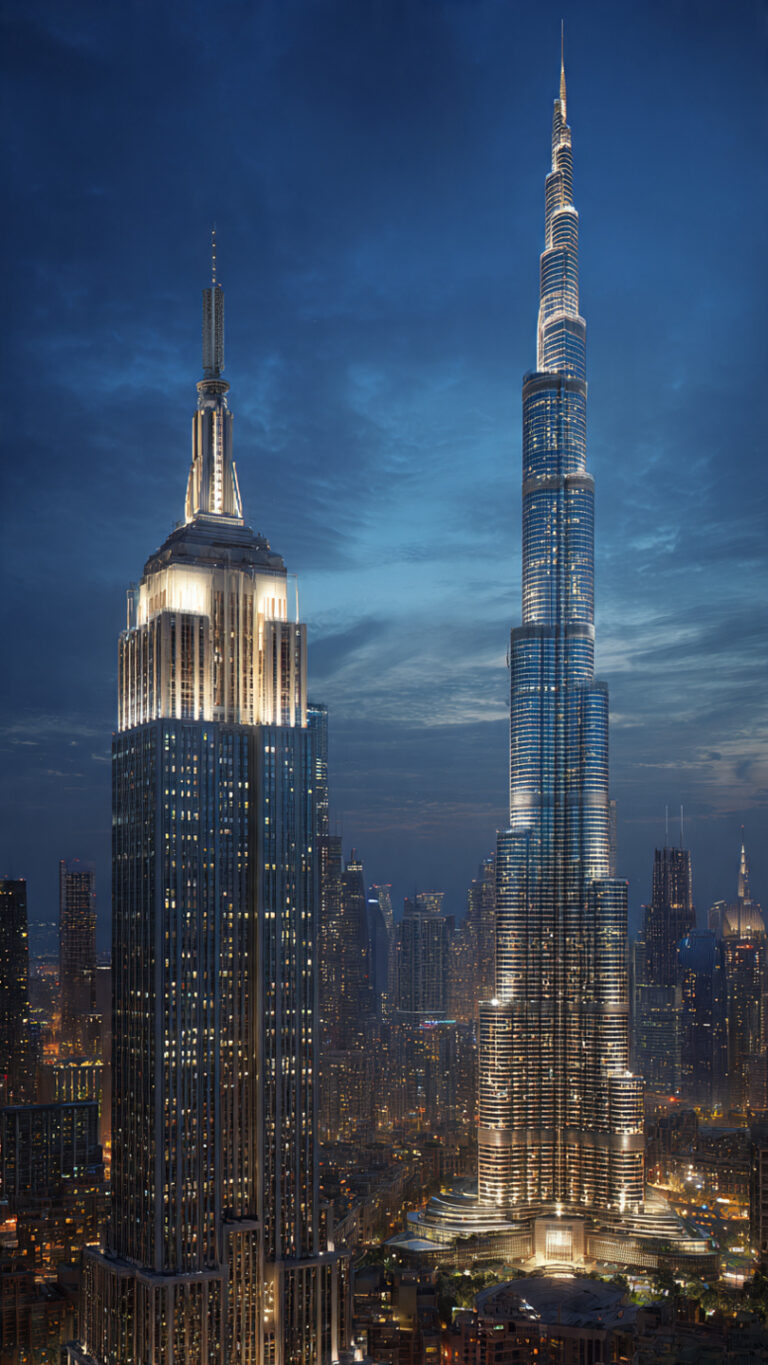
The Empire State Building uses enough electricity to power 40,000 homes. The White House has 132 rooms. The Burj Khalifa is so tall that people at the top see the sun several minutes after people at the bottom.
But here’s a question nobody asks: How many solar panels would it take to power them?
We ran the numbers through our Solar Panel Sizing Calculator. The answers range from “surprisingly achievable” to “you’d need to cover a small country.”
The Empire State Building: 2.7 Million Square Feet of Art Deco
The Building
The Empire State Building isn’t just a tourist attraction — it’s a small city in the sky. With 2.7 million square feet of office space, it houses over 1,000 businesses and approximately 20,000 workers and visitors daily.
Energy Consumption
According to the Empire State Realty Trust’s own sustainability reports, the building underwent a massive energy retrofit completed in 2011 that reduced its energy consumption by 38%. Today, it uses approximately 42 million kilowatt-hours (kWh) per year.
That’s about 115,000 kWh per day — equivalent to roughly 3,800 average American homes.
The Solar Math
Let’s break this down using our Solar Panel Sizing Calculator:
- Annual consumption: 42,000,000 kWh
- Monthly consumption: 3,500,000 kWh
- Daily consumption: 115,000 kWh
- Location: New York City (approximately 4.0 peak sun hours per day, per NREL data)
- Panel wattage: 400W (modern commercial-grade panels)
- System losses: 14% (standard for large installations)
The calculation:
- Daily energy needed: 115,000 kWh ÷ (1 – 0.14) = 133,721 kWh (accounting for system losses)
- System size needed: 133,721 kWh ÷ 4.0 peak sun hours = 33,430 kW DC
- Number of 400W panels: 33,430 kW ÷ 0.4 kW = 83,575 solar panels
Could It Fit?
A 400W panel is approximately 1.8 square meters (about 19 square feet). The total panel area would be:
83,575 × 1.8 m² = 150,435 square meters (about 1.6 million square feet)
The Empire State Building’s roof area? About 79,000 square feet. So no — the panels wouldn’t fit on the roof. You’d need about 20 Empire State Building roofs to hold them all.
Verdict: Powering the Empire State Building entirely with solar on-site is impossible. But a solar farm covering about 37 acres (roughly 28 football fields) could do it.
The White House: 132 Rooms, One Famous Address
The Building
The White House contains 132 rooms, 35 bathrooms, 28 fireplaces, 8 staircases, and 3 elevators across 55,000 square feet. It’s part residence, part office, part museum, part event venue, and part command center.
Energy Consumption
The White House doesn’t publish its exact electricity bills (national security and all that), but based on the General Services Administration data for similar-sized government buildings of this type, and the White House’s own public statements about its energy conservation efforts, we can make a well-informed estimate.
A building of this size, age, and usage pattern typically consumes between 850,000 and 1.2 million kWh annually. We’ll use 1,000,000 kWh as our midpoint — roughly what 33 average American homes use in a year.
The White House also installed solar panels in 2014 during the Obama administration (returning after a previous set installed by Jimmy Carter was removed by Ronald Reagan), but the exact capacity wasn’t fully disclosed. Reports suggest approximately 6.3 kW of generating capacity, which is modest.
The Solar Math
- Annual consumption: 1,000,000 kWh
- Location: Washington, D.C. (approximately 4.2 peak sun hours per day, per NREL)
- Panel wattage: 400W
- System losses: 14%
The calculation:
- Daily energy: 2,740 kWh ÷ 0.86 = 3,186 kWh
- System size: 3,186 kWh ÷ 4.2 hours = 759 kW DC
- Number of panels: 759 kW ÷ 0.4 kW = 1,897 solar panels
Could It Fit?
1,897 panels × 1.8 m² = 3,415 m² (about 37,000 square feet)
The White House roof? About 50,000 square feet across its various sections (including the flat areas used for HVAC equipment and the sloped areas). So technically yes — the panels would physically fit on the White House grounds if you covered the roof and portions of the surrounding property.
Verdict: The White House could theoretically be solar-powered with about 1,900 panels. The roof alone might not hold them all, but with the South Lawn available (and a very understanding National Park Service), it’s physically possible.
Related: The History of Solar Power: From 7th Century BC Burning Mirrors to Modern Panels — including the White House’s own solar story.
The Burj Khalifa: Half a Mile Into the Sky
The Building
The Burj Khalifa stands 828 meters (2,717 feet) tall with 163 floors. It contains 300,000 square meters (3.2 million square feet) of residential and commercial space. It’s so tall that the ambient temperature at the top is typically 6°C (11°F) cooler than at the base — which actually helps with air conditioning loads.
Energy Consumption
The Burj Khalifa’s energy consumption is staggering. According to building management reports and Dubai Electricity and Water Authority data, the tower uses approximately 250 million kWh per year.
To put that in perspective: that’s enough electricity to power about 23,000 average American homes. The air conditioning alone — fighting Dubai’s 45°C (113°F) summer heat across 163 floors — accounts for roughly 40% of that load.
The Solar Math
- Annual consumption: 250,000,000 kWh
- Location: Dubai, UAE (approximately 6.0 peak sun hours per day — one of the best locations on Earth for solar, per NREL and IRENA data)
- Panel wattage: 400W
- System losses: 14%
The calculation:
- Daily energy: 684,932 kWh ÷ 0.86 = 796,432 kWh
- System size: 796,432 kWh ÷ 6.0 hours = 132,739 kW DC
- Number of panels: 132,739 kW ÷ 0.4 kW = 331,847 solar panels
Could It Fit?
331,847 panels × 1.8 m² = 597,325 m² (about 6.4 million square feet, or 148 acres)
That’s about two Disneylands worth of solar panels. The Burj Khalifa sits on a 104,210 m² site (about 26 acres). So no — you’d need about six Burj Khalifa sites covered entirely in panels to power the building itself.
Verdict: Not even close. Even in one of the sunniest places on Earth, the Burj Khalifa consumes so much energy that solar self-sufficiency on-site is impossible. The UAE is actually building massive solar farms elsewhere — including the Mohammed bin Rashid Al Maktoum Solar Park, which will eventually cover 77 square kilometers (30 square miles).
Related: What If We Covered the Sahara in Solar Panels? (The Math Behind the Dream)
Your Local Walmart: The Retail Giant
The Building
The average Walmart Supercenter is approximately 180,000 square feet. There are over 4,600 Walmarts in the United States alone. They’re open 24 hours (in many locations), brightly lit, climate-controlled, and filled with refrigerators and freezers.
Energy Consumption
Walmart has been surprisingly transparent about its energy usage as part of its corporate sustainability goals. According to Walmart’s own ESG (Environmental, Social, and Governance) reports and EPA Green Power Partnership data:
The average Walmart Supercenter uses approximately 1,000,000 kWh per year — very similar to the White House estimate, but for a building more than three times the size. (Commercial buildings are generally more energy-efficient per square foot than historic residential-government hybrids.)
Walmart is also one of the largest corporate solar adopters in the United States, with solar installations on hundreds of stores generating a combined capacity of over 250 MW.
The Solar Math
- Annual consumption: 1,000,000 kWh
- Location: Varies (we’ll use Kansas — geographic center of the contiguous US — at approximately 5.0 peak sun hours, per NREL)
- Panel wattage: 400W
- System losses: 14%
The calculation:
- Daily energy: 2,740 kWh ÷ 0.86 = 3,186 kWh
- System size: 3,186 kWh ÷ 5.0 hours = 637 kW DC
- Number of panels: 637 kW ÷ 0.4 kW = 1,593 solar panels
Could It Fit?
1,593 panels × 1.8 m² = 2,867 m² (about 31,000 square feet)
A Walmart Supercenter roof is about 180,000 square feet. The panels would cover about 17% of the roof. Walmart has already done this math — many of their stores already have solar panels covering 20-40% of their roof area.
Verdict: Very achievable. In fact, Walmart is already doing it at scale. A typical Supercenter could potentially generate 25-40% of its electricity from rooftop solar, with the remainder supplemented by off-site solar farms.
Your Own Home: The One That Actually Matters
The Building
The average American home is about 2,300 square feet (down from a peak of 2,500+ in 2015, per Census Bureau data), housing approximately 2.5 people.
Energy Consumption
According to the U.S. Energy Information Administration (EIA), the average American household consumes approximately 10,500 kWh per year, or about 875 kWh per month. This varies significantly by region:
- Louisiana (highest): 14,400 kWh/year (lots of air conditioning)
- Hawaii (lowest): 6,000 kWh/year (mild climate, high electricity costs drive conservation)
- US average: 10,500 kWh/year
The Solar Math
Let’s run three scenarios using our Solar Panel Sizing Calculator:
Scenario 1: Phoenix, Arizona (6.5 peak sun hours)
- System size: 875 kWh ÷ 30 days = 29.2 kWh/day ÷ 0.86 = 33.9 kWh ÷ 6.5 hours = 5.2 kW
- Panels needed (400W): 5.2 kW ÷ 0.4 = 13 panels
- Roof space: 13 × 19 sq ft = 247 sq ft
Scenario 2: Kansas City, Missouri (5.0 peak sun hours)
- System size: 29.2 kWh ÷ 0.86 = 33.9 kWh ÷ 5.0 hours = 6.8 kW
- Panels needed (400W): 6.8 kW ÷ 0.4 = 17 panels
- Roof space: 17 × 19 sq ft = 323 sq ft
Scenario 3: Seattle, Washington (3.5 peak sun hours)
- System size: 29.2 kWh ÷ 0.86 = 33.9 kWh ÷ 3.5 hours = 9.7 kW
- Panels needed (400W): 9.7 kW ÷ 0.4 = 24 panels
- Roof space: 24 × 19 sq ft = 456 sq ft
Could It Fit?
The average American home has about 1,500-2,000 square feet of roof space (the footprint plus overhangs, adjusted for pitch). Solar panels typically go on the south-facing portion.
- Phoenix: 247 sq ft needed — easily fits on almost any home
- Kansas City: 323 sq ft needed — fits most homes
- Seattle: 456 sq ft needed — fits most homes, though may need both south and west-facing sections
Verdict: Yes. Most American homes can fit enough solar panels to offset 100% of their electricity use. The exact number depends on your location, roof orientation, and energy consumption.
Related: Solar Panel ROI: The Year Your Panels Start Paying You
How We Calculated Each One
Every calculation in this article used the same methodology — the same one built into our Solar Panel Sizing Calculator:
- Annual energy consumption — sourced from building management reports, ESG disclosures, or EIA data
- Daily energy need — annual ÷ 365
- System losses adjustment — daily need ÷ (1 – system losses), typically 14%
- Peak sun hours — from NREL’s National Solar Radiation Database for each location
- System size — adjusted daily need ÷ peak sun hours
- Panel count — system size ÷ panel wattage (400W standard)
Data sources used:
- Empire State Realty Trust sustainability reports
- U.S. Energy Information Administration (EIA) residential energy data
- NREL National Solar Radiation Database for peak sun hours
- Dubai Electricity and Water Authority for Burj Khalifa estimates
- Walmart corporate ESG reports and EPA Green Power Partnership
- U.S. Census Bureau for average home size data
- General Services Administration for government building benchmarks
Size Your Own Solar System
Curious how many panels your home — or any building — would need?
Try our Solar Panel Sizing Calculator. Enter your monthly electricity usage, your location’s peak sun hours, and your preferred panel wattage. It’ll tell you exactly how many panels you need, how much roof space they’ll take, and even estimate your annual production and carbon offset.
No sign-up. No data collection. Everything runs in your browser.
Related Tools & Articles
| Tool | What It Does |
| Solar Panel Sizing Calculator | Calculate exactly how many panels you need |
| Solar Panel ROI Calculator | See when your panels start paying you back |
| Cable Ampacity Calculator | Size the wires for your solar installation |
| Battery Bank Calculator | Add storage to your solar system |
Related blog posts:
- The History of Solar Power: From 7th Century BC Burning Mirrors to Modern Panels
- What If We Covered the Sahara in Solar Panels? The Math Behind the Dream
- Solar Panel ROI: The Year Your Panels Start Paying You
- The Strangest Things People Have Powered With Solar Energy
Disclaimer: This article is for entertainment and educational purposes. Building energy estimates are based on publicly available data and reasonable assumptions. Actual energy consumption varies. Solar panel calculations assume ideal conditions. Consult a certified solar installer for a professional assessment of your property.
Data referenced: Empire State Realty Trust (2024 sustainability report), U.S. EIA Residential Energy Consumption Survey (2023), NREL National Solar Radiation Database, Walmart ESG Report (2024), U.S. Census Bureau American Housing Survey.
About the Author