By the QuantonTools Team
In 1954, The New York Times ran a front-page story with a headline that now seems prophetic: “Vast Power of the Sun Is Tapped By Battery Using Sand Ingredient.”
That “sand ingredient” was silicon. The “battery” was the world’s first practical solar cell. And the “vast power of the sun” would, seven decades later, become the cheapest source of electricity in human history.
But the story of solar power doesn’t start in a Bell Labs laboratory in 1954. It starts 2,600 years earlier, with burning mirrors, ancient Greek philosophers, and a surprisingly prescient understanding of what sunlight could do.
7th Century BC: The Burning Mirrors
The earliest known use of solar energy wasn’t for electricity — it was for fire.
In the 7th century BC, the ancient Greeks and Chinese independently discovered that curved mirrors could concentrate sunlight intensely enough to ignite wood. The Greeks called them “burning mirrors” (purseia). The Chinese called them “yang-sui” — sun-fire devices.
According to legend, Archimedes used an array of polished bronze shields to focus sunlight onto Roman ships attacking Syracuse in 212 BC, setting them ablaze. MIT students famously tested this in 2005 — it kind of worked, though the ships needed to be stationary and coated in pitch. The legend is probably more myth than history, but the science behind it is sound.
The principle these ancients discovered — concentrating solar radiation — is the same one used by modern concentrated solar power (CSP) plants. The Ivanpah Solar Electric Generating System in the Mojave Desert uses 173,500 mirrors (heliostats) to focus sunlight onto boilers atop 140-meter towers. Archimedes would recognize the technology instantly.
1767: The First Solar Oven
The next major leap came from an unexpected source: a Swiss naturalist traveling in Africa.
Horace-Bénédict de Saussure, born in 1740 in Geneva, was a polymath — geologist, meteorologist, physicist, and Alpine explorer. He was fascinated by heat and how to trap it.
In 1767, de Saussure built what he called a “hot box” — essentially five glass boxes nested inside each other, mounted on a black wooden base. When placed in direct sunlight, the innermost box reached 87.5°C (189.5°F). De Saussure had invented the solar oven.
His design was remarkably effective. The multiple glass layers trapped solar radiation (a miniature greenhouse effect), while the black interior absorbed and retained heat. De Saussure was so impressed by his creation that he wrote: “Someday some usefulness might be drawn from this device.”
He was right. Modern solar ovens using the same principle are deployed in developing regions where fuel is scarce. The Solar Cookers International organization estimates that solar cooking reduces deforestation and respiratory illness for millions of households globally.
But de Saussure’s hot box was about trapping heat, not generating electricity. That breakthrough would take another 72 years.
1839: The Photovoltaic Effect
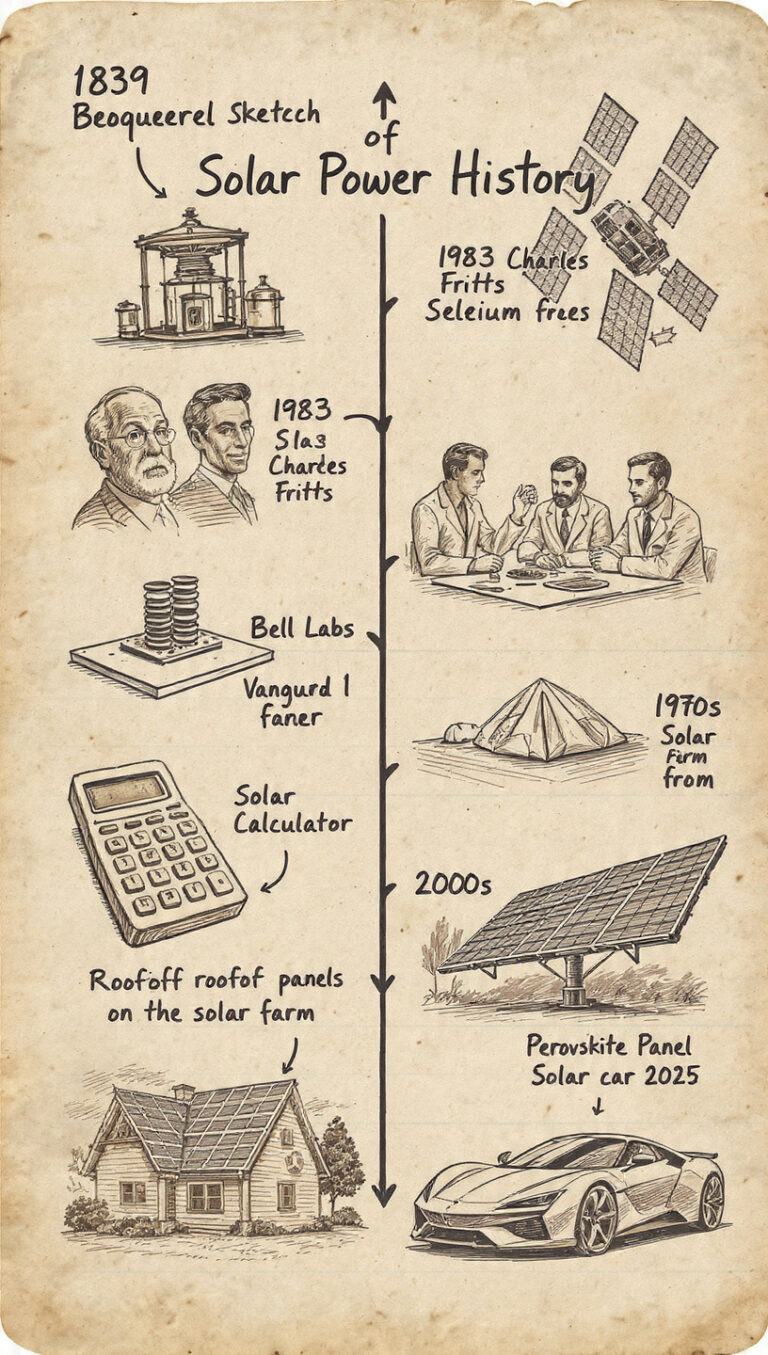
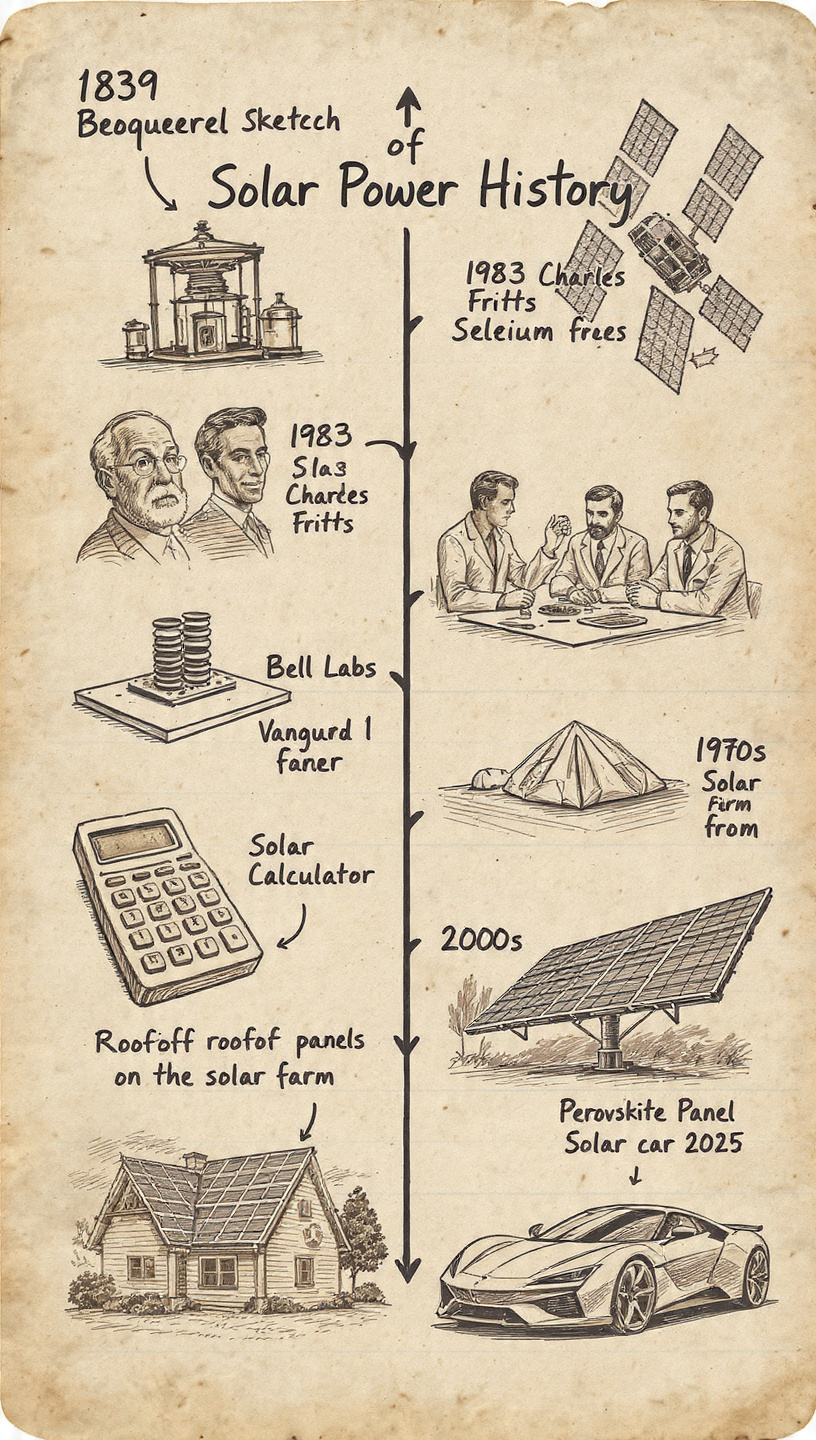
In 1839, a 19-year-old French physicist named Alexandre-Edmond Becquerel made one of the most important discoveries in energy history — and it was almost an accident.
Becquerel was experimenting in his father’s laboratory (his father, Antoine César Becquerel, was also a prominent physicist) with metal electrodes dipped in an electrolyte solution. He noticed something peculiar: when he exposed one of the electrodes to sunlight, a small electric current flowed.
He had discovered the photovoltaic effect — the conversion of light directly into electricity.
Becquerel published his findings in a scientific paper titled “On Electric Effects Produced Under the Influence of Solar Radiation.” The academic community was intrigued but saw no practical application. Solar cells would remain a laboratory curiosity for another 115 years.
But the seed was planted. Light could become electricity. The question was: how to make it useful?
1883: The First Solar Cell
The first working solar cell was built by an American inventor named Charles Fritts in 1883 — and it was terrible by modern standards.
Fritts coated selenium (a semiconductor) with an extremely thin layer of gold to create a junction. When sunlight hit the selenium, it generated a tiny electric current. The efficiency was less than 1% — meaning less than 1% of the sunlight hitting the cell became electricity.
Fritts sent samples to Werner von Siemens, the German electrical industrialist. Siemens was impressed enough to present Fritts’ cells to the Royal Academy of Sciences in Berlin, calling them “scientifically of the most far-reaching importance.”
But commercially, they went nowhere. At less than 1% efficiency, you’d need a football field of selenium cells to power a single light bulb. The economics didn’t work.
The underlying problem was materials. Selenium was the wrong semiconductor. The breakthrough would require a different element entirely — one that came from sand.
1954: Bell Labs and the Silicon Revolution
On April 25, 1954, three scientists at Bell Laboratories in Murray Hill, New Jersey, changed energy history.
Daryl Chapin, Calvin Fuller, and Gerald Pearson had been working on a problem: how to power telephone equipment in remote locations where changing batteries was impractical. Chapin was investigating wind power. Fuller and Pearson were experimenting with silicon semiconductors for electronics.
Pearson accidentally discovered that silicon doped with certain impurities was dramatically more photosensitive than selenium. Working together, the trio built the first practical silicon solar cell.
Their cell achieved 6% efficiency — six times better than anything before it. The New York Times declared it would lead to “the harnessing of the almost limitless energy of the sun for the uses of civilization.”
The Bell Labs announcement in 1954 was a media sensation. They demonstrated the cells powering a small Ferris wheel toy and a radio transmitter. Reporters were fascinated. The public was captivated.
But there was still the problem of cost. Those first Bell Labs cells cost about $1,785 per watt to produce. To put that in perspective: at those prices, powering an average American home with solar would cost approximately $15-20 million.
The only market that could afford it? Space exploration.
1958-1970s: The Space Race Era
In 1958, the U.S. Navy launched Vanguard 1 — the fourth artificial satellite in orbit and the first to be powered by solar cells. Its six silicon solar panels produced just 1 watt of power, but that was enough to run its radio transmitter.
Vanguard 1’s solar panels outlasted its chemical batteries by years. The satellite transmitted data until 1964 and is still orbiting today — the oldest artificial satellite still in space.
Solar quickly became the standard for satellite power. The Telstar communications satellite (1962), the Nimbus weather satellites, and eventually Skylab (1973) all used solar arrays. NASA became the world’s largest buyer of solar cells.
The space program drove early solar development. The panels needed to be lightweight, radiation-resistant, and reliable. Engineers improved efficiency from 6% to 10%, then 14%. Manufacturing techniques improved. But costs remained high for terrestrial use — still around $100 per watt in the early 1970s.
That was about to change.
1973-1980s: The Oil Crisis Solar Boom
In October 1973, the Organization of Arab Petroleum Exporting Countries (OAPEC) imposed an oil embargo against nations supporting Israel during the Yom Kippur War. Oil prices quadrupled overnight. Gasoline lines stretched for blocks. The world suddenly realized its dependence on fossil fuels.
Governments poured money into alternative energy research. The U.S. Department of Energy was created in 1977. Solar R&D funding jumped from essentially zero to hundreds of millions of dollars.
The oil crisis launched the first solar boom. Companies like ARCO Solar (a division of Atlantic Richfield, an oil company) began mass-producing solar panels. By the mid-1970s, panel costs had dropped to around $20 per watt — still expensive, but no longer astronomical.
President Jimmy Carter installed solar thermal panels on the White House roof in 1979. At the dedication ceremony, he said: “In the year 2000, this solar water heater… will still be here, supplying cheap, efficient energy. A generation from now, this solar heater can either be a curiosity, a museum piece, an example of a road not taken, or it can be just a small part of one of the greatest and most exciting adventures ever undertaken by the American people.”
In 1986, the Reagan administration removed those panels during roof repairs. They were not reinstalled. (Some were eventually sent to Unity College in Maine, where they heated water for the cafeteria. One now resides in the Smithsonian.)
When oil prices stabilized in the mid-1980s, government solar funding evaporated. The U.S. solar industry collapsed. But the seeds of a global revolution had been planted elsewhere.
1990s: Japan and the Distributed Solar Model
While the U.S. stepped back from solar, Japan stepped forward.
In 1994, the Japanese government launched the “70,000 Roofs” program — an ambitious subsidy to install solar panels on residential rooftops across the country. The goal was to create a domestic solar market, drive manufacturing scale, and reduce costs through mass production.
It worked. By the end of the 1990s, Japan had installed more solar capacity than any other country. Japanese companies like Sharp, Kyocera, and Sanyo became global leaders in solar manufacturing.
Japan’s model — government subsidies for distributed rooftop solar, creating a domestic market that drives manufacturing scale — would later be copied by Germany, then China, then the world.
2000s: Germany’s Solar Revolution
If Japan planted the solar seed, Germany made it blossom.
In 2000, Germany passed the Renewable Energy Sources Act (Erneuerbare-Energien-Gesetz, or EEG). The law introduced feed-in tariffs — guaranteed, above-market prices that utilities had to pay anyone who generated solar electricity and fed it into the grid.
The economics were transformative. A German homeowner could install solar panels, sell the electricity at a guaranteed premium price for 20 years, and earn a reliable return on investment. Banks began offering solar loans. Installation companies multiplied. Manufacturing scaled dramatically.
Germany — a country with less annual sunshine than Alaska — became the world’s largest solar market. By 2010, Germany had installed over 17,000 MW of solar capacity, more than the rest of the world combined at the time.
The German solar boom proved that solar worked anywhere, not just in sunny deserts. It created the global mass market that would ultimately drive costs down by over 90%.
2010s: China’s Manufacturing Revolution
China entered the solar market later than Germany but scaled faster than anyone imagined possible.
Between 2010 and 2020, Chinese manufacturers invested hundreds of billions of dollars in solar panel production capacity. They built massive factories, vertically integrated supply chains, and relentlessly drove down costs through scale and automation.
The results were staggering. According to BloombergNEF data, the average cost of solar panels fell from approximately $2.00 per watt in 2010 to around $0.20 per watt by 2020 — a 90% reduction in one decade.
In 2020, the International Energy Agency (IEA) declared solar photovoltaic power “the cheapest electricity in history” in its World Energy Outlook. For the first time, building new solar was cheaper than operating existing coal plants in many parts of the world.
The 2010s also saw the rise of utility-scale solar farms. The Bhadla Solar Park in Rajasthan, India, covers 56 square kilometers (14,000 acres) and generates 2,245 MW — enough to power over a million homes. The Tengger Desert Solar Park in China, nicknamed the “Great Wall of Solar,” stretches across 43 square kilometers.
Today: Perovskites, Bifacial Panels, and the Terawatt Era
Solar technology continues to advance at remarkable speed.
Perovskite solar cells — named after the mineral crystal structure they use — are the most promising next-generation technology. They can be manufactured using simple printing processes, are flexible and lightweight, and have achieved laboratory efficiencies exceeding 33% in tandem with silicon cells (compared to about 22-24% for standard silicon alone). Oxford PV, a British company, began commercial production of perovskite-silicon tandem cells in 2024.
Bifacial panels — which capture sunlight on both the front and back sides, using reflected light from the ground — are becoming the standard for utility-scale installations. They can generate 5-30% more energy than traditional single-sided panels depending on ground reflectivity (albedo).
Floating solar (“floatovoltaics”) is the fastest-growing segment. Panels mounted on reservoirs, lakes, and near-shore ocean areas save land, reduce water evaporation, and operate more efficiently due to water cooling. The Saemangeum floating solar project in South Korea, currently under construction, will generate 2.1 GW — enough for over 600,000 homes.
Global solar capacity passed 1 terawatt (1,000 GW) in 2022, according to the IEA. At current growth rates, it will pass 2 terawatts by 2026 and is projected to reach 5-10 terawatts by 2035.
Your Place in Solar History
The history of solar power is a story of human ingenuity spanning 2,600 years — from ancient Greek mirrors to 19th-century laboratory discoveries, from space-age satellites to 21st-century terawatt-scale deployment.
But the most important chapter is the one being written right now: the chapter where solar power becomes accessible to everyone.
You don’t need to be a Bell Labs scientist or a German energy minister. You don’t need to build a 2,000 MW solar farm in the Indian desert. You just need to know whether solar makes sense for your home, your budget, and your location.
Our Solar Panel Sizing Calculator tells you exactly how many panels you’d need based on your actual electricity usage and local sun hours. No sign-up. No data collection. Just math.
And if you’re wondering about the economics, our Solar Panel ROI Calculator shows you when your panels would start paying you back — including state incentives, tax credits, and electricity rate projections.
Related Tools & Articles
| Tool | What It Does |
| Solar Panel Sizing Calculator | Calculate exactly how many panels you need |
| Solar Panel ROI Calculator | See when your panels start paying you back |
| Battery Bank Calculator | Add storage to your solar system |
| Cable Ampacity Calculator | Size the wires for your installation |
Related blog posts:
- How Many Solar Panels Would It Take to Power Famous Buildings? We Did the Math
- What If We Covered the Sahara in Solar Panels? The Math Behind the Dream
- Solar Panel ROI: The Year Your Panels Start Paying You
- The Strangest Things People Have Powered With Solar Energy
- Solar Panels at Night? The Moonlight Myth Debunked
This article is for educational and entertainment purposes. Solar panel costs, incentives, and performance vary by location, installer, and technology generation. Data sources: NREL National Solar Radiation Database, IEA World Energy Outlook 2024, BloombergNEF solar pricing data, Bell Laboratories historical archives, De Saussure original papers (1767), Becquerel original paper (1839), U.S. Department of Energy solar history timeline.
About the Author