By the QuantonTools Team
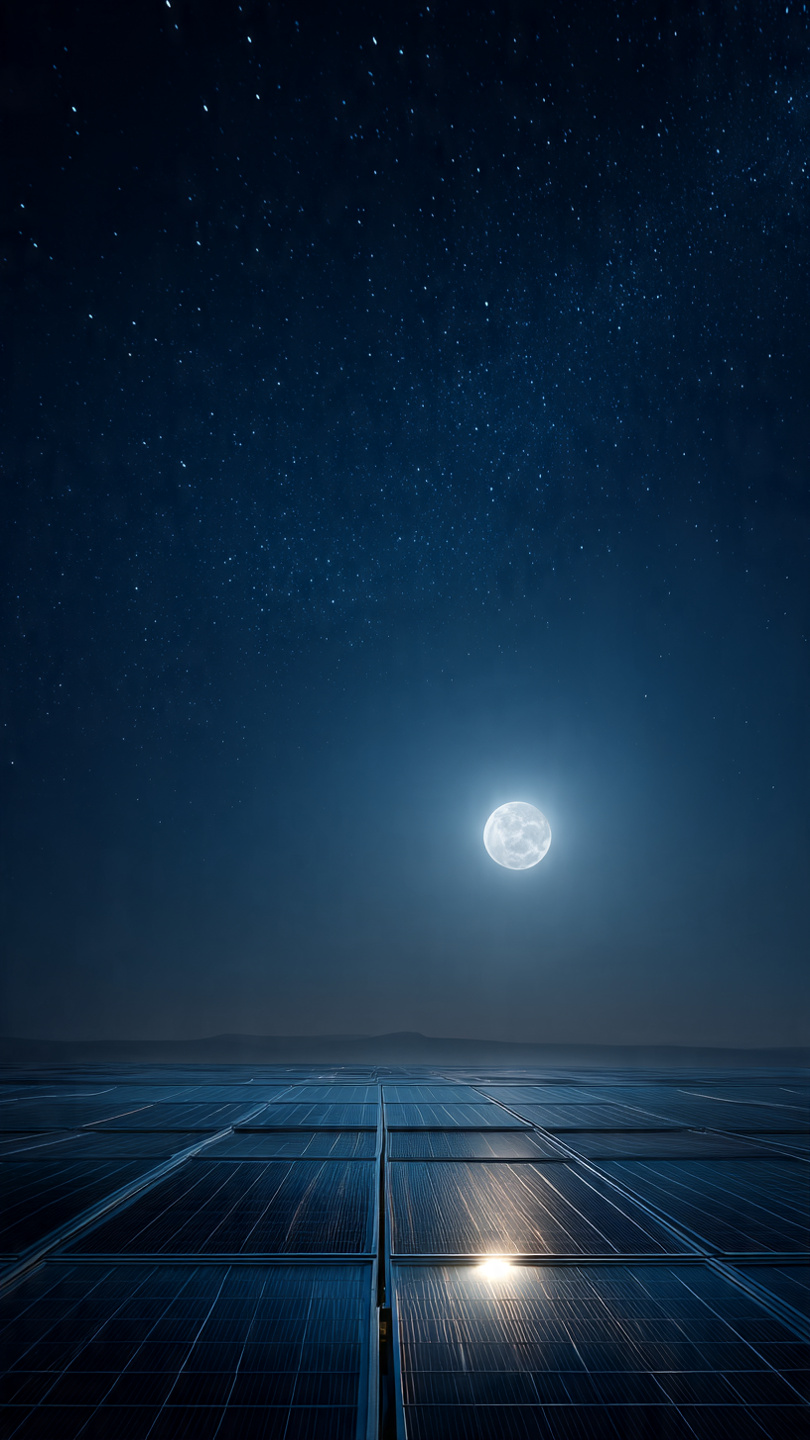
Every few months, a viral post makes the rounds: “Did you know solar panels work at night using moonlight?”
The comments fill with excitement. “Finally, the solution to solar’s biggest problem!” “Why isn’t anyone talking about this?”
Here’s why: because the math says it’s ridiculous.
But the real story — what actually happens to solar panels at night, and the emerging technology that might genuinely change things — is far more interesting than the myth.
The Physics: Solar Panels Need Photons
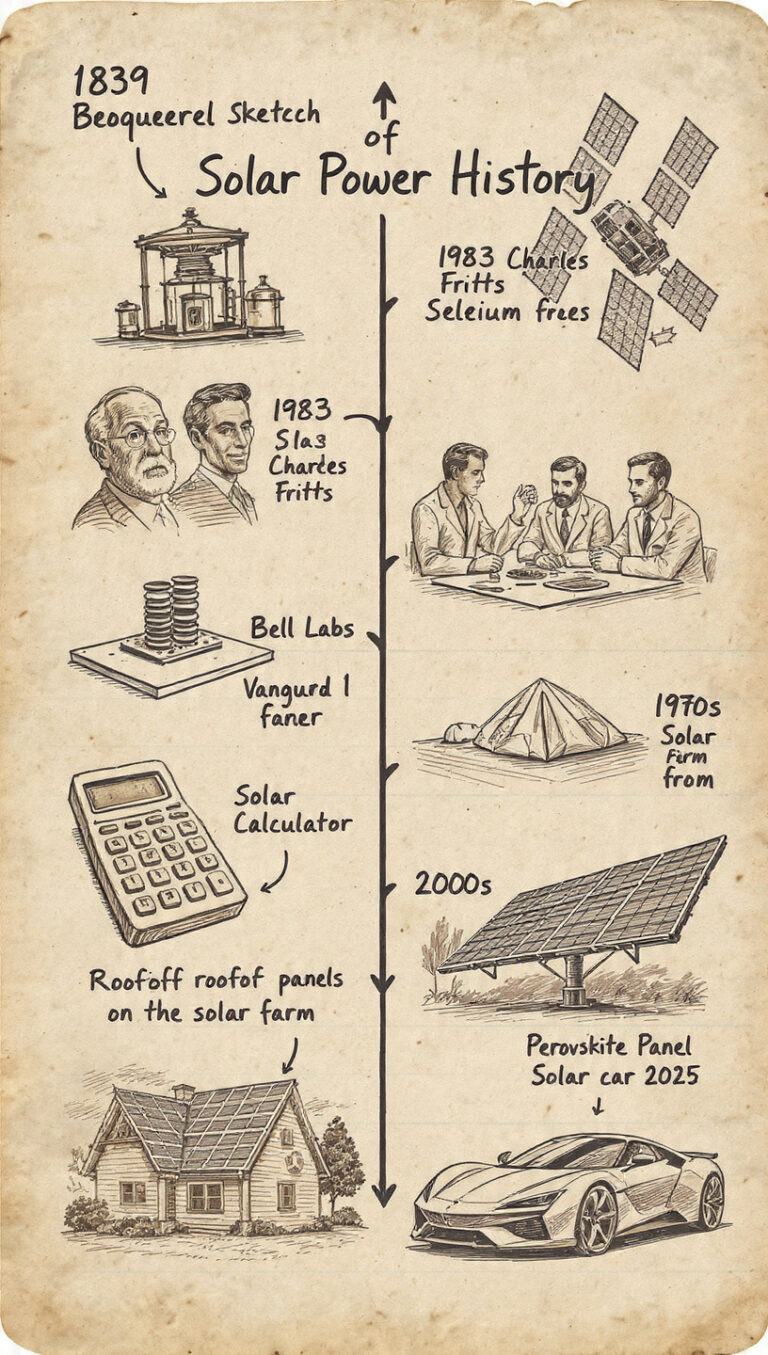
Solar panels work through the photovoltaic effect, discovered by Edmond Becquerel in 1839: when photons (particles of light) strike certain materials, they knock electrons loose, creating an electric current.
The key word here is photons. No photons, no electricity.
The sun bathes the Earth in an enormous number of photons. At the top of the atmosphere, the solar constant is approximately 1,361 watts per square meter. At ground level on a clear day, after passing through the atmosphere, it’s typically 800-1,000 W/m².
Solar panels are rated based on this standard: a “400-watt panel” produces 400 watts under standard test conditions of 1,000 W/m² irradiance.
So the question isn’t “can solar panels work at night?” — it’s “are there enough photons at night to generate meaningful electricity?”
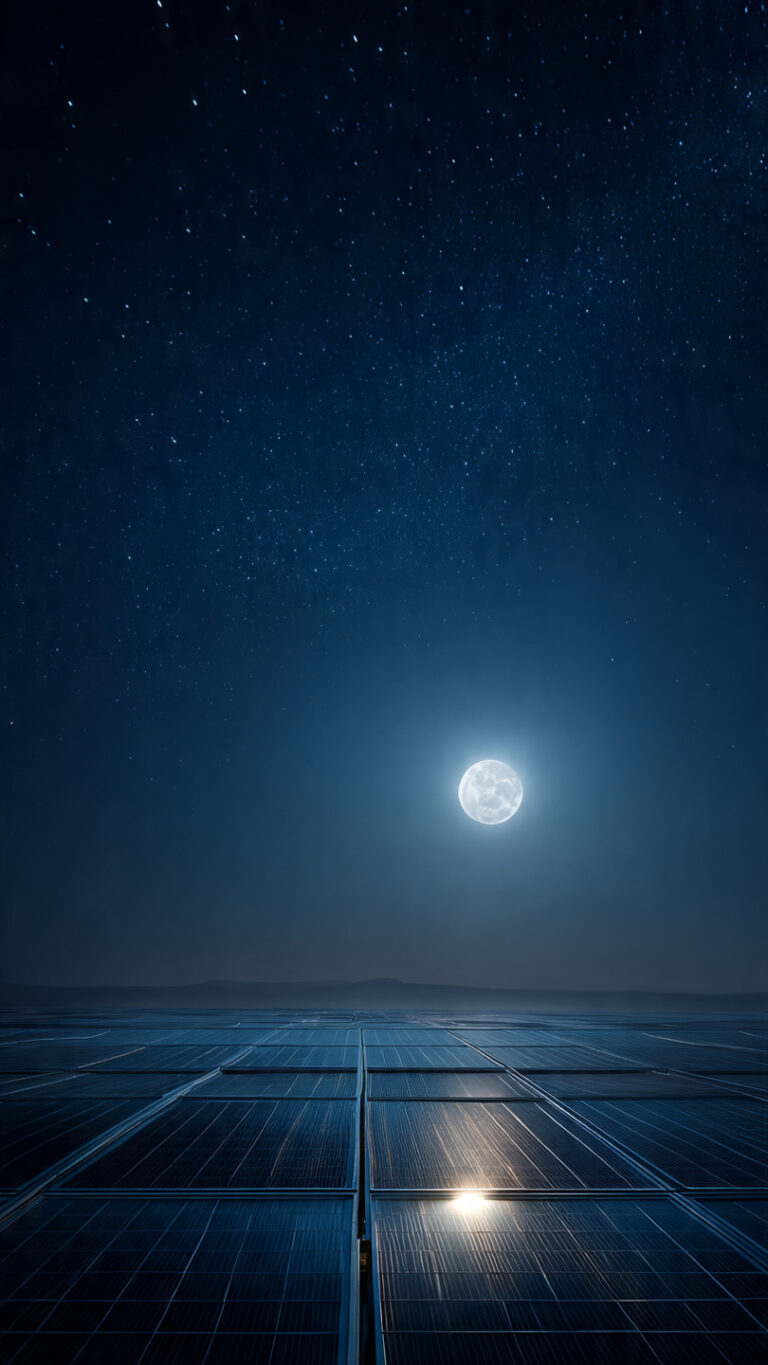
Moonlight: Reflected Sunlight, Dramatically Dimmer
The moon doesn’t produce its own light. It reflects sunlight. And it’s terrible at it.
The moon’s albedo (reflectivity) is approximately 0.12 — meaning it reflects only about 12% of the sunlight that hits it. The rest is absorbed.
But that’s not the main problem. The main problem is distance and geometry.
Sunlight travels 150 million kilometers from the sun to the moon, reflects off the lunar surface (scattering in all directions), then travels another 384,000 kilometers to Earth. By the time it arrives, moonlight is approximately 1/400,000th as intense as direct sunlight.
In numbers:
- Direct sunlight: ~1,000 watts per square meter
- Full moonlight: ~0.0025 watts per square meter (2.5 milliwatts)
- That’s 0.00025% of daytime intensity
What does this mean for a solar panel?
A 400-watt solar panel exposed to full moonlight would generate approximately 0.001 watts — one milliwatt. That’s not enough to light a single LED indicator, let alone charge a phone or power a home.
To put it in perspective:
- You’d need about 400,000 solar panels in moonlight to generate the same power as one panel in direct sunlight
- A 10 kW solar array (about 25 typical panels) would generate roughly 0.025 watts in moonlight — less power than a wristwatch battery
So technically, yes — solar panels “work” in moonlight in the sense that the photovoltaic effect still occurs. Practically, the output is so small it’s completely useless for any real application.
Streetlights: Even Worse Than You Think
If moonlight is too dim, what about streetlights? Cities are brightly lit at night — surely solar panels could capture some of that?
The math here is even more humbling.
A typical LED streetlight produces about 5,000-15,000 lumens. At a distance of 10 meters (33 feet), the illuminance on a surface is approximately 50-150 lux (lumens per square meter).
Converting lux to watts per square meter depends on the light spectrum, but for typical LED streetlights, 1 lux ≈ 0.003 W/m².
So at 10 meters from a streetlight: 150 lux × 0.003 = 0.45 W/m²
A solar panel under that streetlight would receive about 0.045% of standard sunlight intensity. A 400-watt panel would generate approximately 0.18 watts — enough to faintly illuminate its own spec sheet.
But here’s the real kicker: that streetlight is powered by electricity from the grid. If you used that electricity to charge a battery directly, you’d get about 90% efficiency. Routing it through a streetlight (which is about 40% efficient at converting electricity to light) and then capturing that light with a solar panel (about 20% efficient) gives you an overall efficiency of approximately 8% — and at a tiny fraction of the panel’s rated capacity.
Using streetlights to power solar panels is energetically worse than just using the grid electricity directly. It’s like filling a swimming pool with a teaspoon — while the hose is right there.
Starlight: Astronomically Dim
On a clear, moonless night, the stars provide approximately 0.0001 lux of illumination — about one ten-millionth the brightness of direct sunlight.
A solar panel under starlight would generate approximately 0.0000001 watts — one ten-millionth of a watt.
You would need about 10 billion solar panels under starlight to match the output of a single panel in sunlight. That’s roughly 50 times the total number of solar panels installed globally as of 2024.
Starlight is not a viable power source. It is, however, a lovely thing to look at while waiting for sunrise.
What Actually Happens to Solar Panels at Night
At night, solar panels don’t “turn off” — they just have nothing to do. Here’s what’s actually happening:
The Electrical Reality
When photons stop arriving, the photovoltaic effect stops. The panel becomes an inert piece of silicon, glass, and aluminum. No current flows. No power is produced.
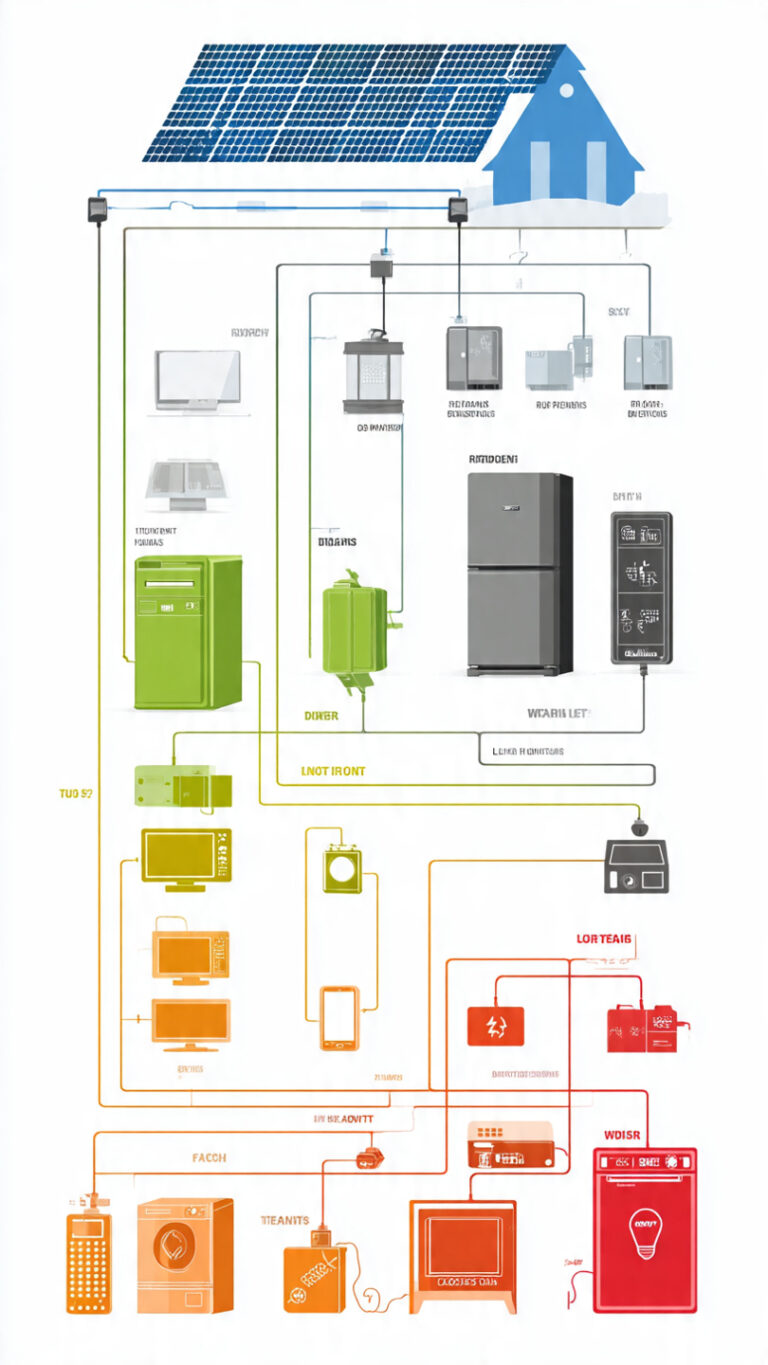
However, the panel is still connected to the electrical system. In grid-tied systems without battery backup, the inverter shuts down automatically when it detects insufficient input voltage — this is a safety feature required by electrical codes (NEC 690, IEC 62109) to prevent the inverter from feeding power back into the grid during an outage (anti-islanding).
The Thermal Reality
Solar panels actually cool down significantly at night, which is a good thing. During the day, panel temperatures can reach 60-70°C (140-158°F) in hot climates, reducing efficiency. At night, they cool to ambient temperature, and morning dew can even help clean dust from the surface.
This nighttime cooling is one reason why solar panels perform better in cooler climates despite receiving the same sunlight — they operate closer to their optimal temperature (25°C / 77°F).
The Energy Reality
Grid-tied solar homes draw power from the grid at night, exactly like homes without solar. The difference is that during the day, the solar panels generated credits (through net metering) that offset — often completely — the nighttime consumption.
Off-grid systems rely on batteries charged during the day. This is the core function of home battery systems like the Tesla Powerwall, LG Chem RESU, and similar products.
The Future: Anti-Solar Cells That Work in Darkness
Here’s where the story gets genuinely exciting — and where the “solar at night” dream might actually come true.
In 2020, researchers at Stanford University and the University of California, Davis published a paper in the journal ACS Photonics demonstrating a device they called an “anti-solar cell” — a photovoltaic cell that generates electricity at night.
The principle is completely different from daytime solar:
- During the day, the Earth absorbs sunlight and warms up
- At night, the Earth radiates that heat back into space as infrared radiation
- The anti-solar cell captures this outgoing infrared radiation — essentially, the Earth’s own heat — and converts it into electricity
The device uses a process called “radiative cooling.” The cell faces the cold night sky (which is approximately -270°C / -454°F in deep space) and radiates heat toward it. The temperature difference between the warm Earth and the cold sky drives a thermoradiative process that generates electricity.
The current output is tiny — approximately 50 milliwatts per square meter, compared to 200+ watts per square meter for daytime solar. That’s about 1/4,000th the output.
But 50 mW/m² is not nothing. Over a large enough area with improved efficiency, nighttime radiative cooling cells could potentially power low-energy devices — sensors, LED lights, communication equipment — without batteries.
Lead researcher Dr. Shanhui Fan told Stanford News: “What we’ve done is take a regular solar cell and run it in reverse. The amount of power is modest, but it demonstrates the principle.”
Other researchers are exploring related approaches. A 2022 paper in Applied Physics Letters demonstrated a thermoelectric generator that uses the temperature difference between a solar panel (which cools rapidly at night) and the surrounding air to generate small amounts of electricity.
The practical applications are still years away, but the physics is sound: there is energy available at night — it’s just thermal rather than photonic, and capturing it requires different technology than standard solar panels.
Why Battery Storage Matters (Right Now)
While researchers work on anti-solar cells, the practical solution to “solar at night” already exists: batteries.
When your solar panels generate more electricity than you use during the day (which they typically do between 10 AM and 4 PM), the excess charges a battery. At night, the battery discharges, powering your home with stored solar energy.
According to the U.S. Energy Information Administration, approximately 15% of residential solar installations in 2024 included battery storage — up from less than 5% in 2019. In California, where net metering policies have changed to incentivize storage, the attachment rate exceeds 30%.
The economics are improving rapidly. Lithium-ion battery pack prices have fallen from approximately $1,200 per kWh in 2010 to around $130 per kWh in 2024, according to BloombergNEF — a 90% reduction. At current prices, a 10 kWh home battery system costs approximately $6,000-$10,000 installed before incentives.
Our Battery Bank Calculator can help you determine how much storage you’d need to power your home through the night.
Calculate Your Battery Needs →
The Bottom Line
| Light Source | Intensity vs Sunlight | 400W Panel Output | Can It Power Anything? |
| Direct Sunlight | 100% | 400 watts | ✅ Your entire home |
| Full Moon | 0.00025% | 0.001 watts | ❌ Not even an LED |
| Streetlight (10m) | 0.045% | 0.18 watts | ❌ A very dim LED |
| Starlight | 0.00001% | 0.00004 watts | ❌ Nothing at all |
| Anti-solar cell (future) | ~0.02% | 0.05 watts | ⚠️ Sensors, small devices |
So no — solar panels don’t work at night, moonlight is a myth, and streetlights are energetically pointless.
But during the day, your panels are generating real, substantial power. The key is sizing your system correctly for your daytime needs and pairing it with battery storage if you want nighttime coverage.
Our Solar Panel Sizing Calculator tells you exactly how many panels you need based on your actual electricity usage and local sun hours. And our Battery Bank Calculator tells you how much storage you’d need to keep the lights on after dark.
Related Tools & Articles
| Tool | What It Does |
| Solar Panel Sizing Calculator | Calculate exactly how many panels you need |
| Solar Panel ROI Calculator | See when your panels start paying you back |
| Battery Bank Calculator | Add storage to your solar system |
| Cable Ampacity Calculator | Size the wires for your installation |
Related blog posts:
- How Many Solar Panels Would It Take to Power Famous Buildings? We Did the Math
- The History of Solar Power: From 7th Century BC Burning Mirrors to Modern Panels
- What If We Covered the Sahara in Solar Panels? The Math Behind the Dream
- Solar Panel ROI: The Year Your Panels Start Paying You
- The Strangest Things People Have Powered With Solar Energy
*This article is for educational and entertainment purposes. Solar irradiance data from NREL and ASTM standards. Moonlight intensity measurements from the Journal of Geophysical Research. Anti-solar cell research from Ono et al. (2020) ACS Photonics, Stanford University. Battery pricing data from BloombergNEF annual battery price survey. Starlight illuminance data from the International Astronomical Union.*
About the Author